

Hey there! As a supplier of nylon products, I often get asked whether nylon products have a high modulus of elasticity. Well, let's dive right into this topic and break it down in a way that's easy to understand.
First off, what exactly is the modulus of elasticity? In simple terms, it's a measure of how stiff a material is. When you apply a force to a material, the modulus of elasticity tells you how much it will deform. A high modulus of elasticity means the material is stiffer and will deform less under a given force, while a low modulus means it's more flexible and will deform more.
Now, let's talk about nylon. Nylon is a type of synthetic polymer that's known for its strength, durability, and versatility. There are different types of nylon, such as nylon 6, nylon 6/6, and MC Nylon black. Each type has its own unique properties, but in general, nylon has a relatively high modulus of elasticity compared to some other polymers.
One of the reasons nylon has a decent modulus of elasticity is its molecular structure. Nylon molecules are long chains that are held together by strong chemical bonds. These bonds give nylon its strength and stiffness. When you apply a force to a nylon product, the chains resist being pulled apart or stretched, which results in less deformation compared to a material with weaker bonds.
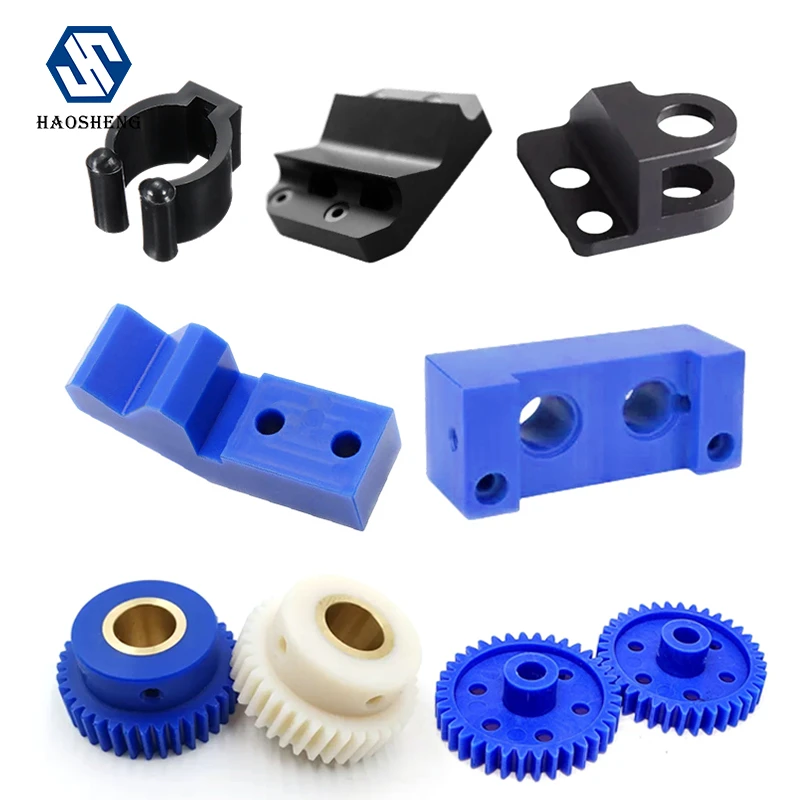
Let's take a look at some specific nylon products. For example, CNC Nylon Parts. These parts are precision - machined from nylon, and they often need to maintain their shape and dimensions under various loads. Thanks to nylon's relatively high modulus of elasticity, CNC nylon parts can withstand mechanical stress without significant deformation. This makes them suitable for a wide range of applications, from automotive components to industrial machinery parts.
Another example is Nylon Plate Sheet. Nylon plates and sheets are used in many industries, such as construction, manufacturing, and electronics. The high modulus of elasticity of nylon plates means they can be used as structural elements. They can support weight and resist bending, making them a great choice for applications where strength and stiffness are required.
Now, let's focus on MC Nylon black. MC Nylon, also known as monomer - cast nylon, is a special type of nylon with even better mechanical properties in some aspects. It has a high molecular weight, which contributes to its high modulus of elasticity. MC Nylon black is often used in applications where high strength and low friction are needed, like bearings and gears. The high modulus of elasticity ensures that these parts can handle the forces and stresses involved in their operation without wearing out or deforming quickly.
However, it's important to note that the modulus of elasticity of nylon can be affected by several factors. Temperature is one of the most significant factors. As the temperature increases, the modulus of elasticity of nylon decreases. This means that nylon becomes more flexible at higher temperatures. So, if you're using nylon products in a high - temperature environment, you need to take this into account.

Moisture is another factor. Nylon is hygroscopic, which means it can absorb water from the surrounding environment. When nylon absorbs moisture, its modulus of elasticity decreases, and it becomes more flexible. This can be a concern in applications where dimensional stability is critical.
In comparison to some other materials, nylon's modulus of elasticity is not as high as that of metals like steel or aluminum. But that's not necessarily a bad thing. Nylon has other advantages, such as its low density, corrosion resistance, and ease of processing. In many applications, the combination of nylon's properties, including its modulus of elasticity, makes it a better choice than metals.
For instance, in the automotive industry, replacing metal parts with nylon parts can reduce the weight of the vehicle, which in turn improves fuel efficiency. The high modulus of elasticity of nylon still allows these parts to perform their functions effectively while providing the weight - saving benefits.
In the electronics industry, nylon products are used because of their electrical insulation properties. The modulus of elasticity ensures that the parts can maintain their shape and position, protecting the delicate electronic components inside.
So, to answer the question “Do nylon products have a high modulus of elasticity?”, it depends on how you define “high”. Compared to some polymers, nylon has a relatively high modulus of elasticity. But when compared to metals, it's lower. However, nylon's unique combination of properties, including its modulus of elasticity, makes it a valuable material in a wide range of applications.
If you're in the market for nylon products, whether it's CNC nylon parts, nylon plate sheets, or MC Nylon black, we're here to help. We have a wide range of nylon products that are manufactured to the highest quality standards. Our team of experts can assist you in choosing the right nylon product for your specific application, taking into account factors like the required modulus of elasticity, temperature, and moisture conditions.
Don't hesitate to reach out to us if you have any questions or if you're interested in starting a procurement discussion. We're always happy to work with you to find the best nylon solutions for your needs.
References
- "Engineering Plastics Handbook" by Hans Domininghaus
- "Polymer Science and Technology" by Donald R. Paul and C. Barry Bucknall